Friday, May 22, 2009

11. The Case of the Rat-Catching Westie

"I have no objection to letting you have the blood samples to give to Vet 1" I said to the two women in their 20s on this fine sunny morning at 9.30 am. My associate who consulted in the evenings and Saturdays had treated the Westie yesterday and told the owners that he suspected liver and kidney diseases. He had told them that the blood samples would be sent to an outside laboratory today. My associate had said that the results would be available after 2 days.

However Vet 1 could produce instant haematological results and the 2 women now wanted the blood to be given to Vet 1 whose instant blood test results would tell them whether the Westie was suffering from liver and kidney diseases.

I checked the case card. The complaint was that the Westie had stopped eating. I had given this 10-year-old Westie dental scaling 2 months ago and he was all right during general examination. I had not requested blood test prior to dental work as that meant extra expenses to the dog owners. Most don't like to pay more and many Singaporean dog owners don't even send their dogs for dental check up and would live with their bad breath for years.

"I am open to owners wishing to have 2nd opinions. But have you considered that Vet 1 may not be elated to receive your blood samples collected by his competitor? He may want to collect blood again as he may not trust the blood from my Surgery. He may say that the blood collected overnight will not be good for the test and therefore he has to collect fresh blood for analysis.

Human behaviour is unpredictable. If he is not happy, do you expect your dog to be well looked after? I had bad encounters with 2 vets in this practice before. When two of my owners wanted the dogs to be treated by them, I made prior phone calls. The two vets were very busy and judging from their phone conversation and mannerism, they would rather not get 2nd hand cases.

The 2 ladies had not thought of such behaviour but they do exist. "In any case, your Westie had been barking for at least half an hour and he sure did not look as if he was going to die soon." My associate had given the necessary IV drips and treatment yesterday evening and I would rather not interfere with his case to avoid confusion.

The apparently elder of the two ladies asked, "If Vet 1 collects blood again, will the blood test be different and affected by the treatment given?"

"Yes," I said. "Your Westie in the animal holding area was barking non-stop for at least 30 minutes this morning. He did not look as if he was going to die soon and therefore needed instant blood tests. In any case, blood test results from this laboratory can be available within 24 hours if we request urgent results"

The ladies vacillated. To go to see a new vet or not to go. Doctor hopping leads higher expenses.

I asked my assistant to bring the Westie into the consultation room for me to examine and then release for the 2nd opinion. There was no point in retaining this client. Mr Saw brought in the Westie and put the dog on the consultation table. The dog stood quietly as I opened his mouth. I showed the gums to the ladies and they could see that the dog had almost white gums. "Your dog has severe anaemia and blood tests would be very useful to help the vet know what is the cause of the anaemia."

Then I palpated the anterior abdominal area. As I felt the stomach area, the Westie shivered and gave a grunt of pain. The two ladies could hear and see his reaction.

"Did you feed chicken bones to this dog?" I asked. "Does he pass black smelly stools and had difficulty passing stools sometimes?"

"Yes," the older lady nodded their head in reply to the 3 questions. "I feed him chicken bones every day."

"Some chicken bones could have lacerated his intestines over the years causing bleeding in the intestines leading to black smelly stool formation. Some fragments of bones could be passed through undigested and got stuck in his rectum temporarily causing pain in passing motion. The prolonged episodes of bleeding would have caused severe anaemia. Of course kidney disease and other internal organ diseases can cause anaemia too."

"What else do you feed this dog?" I asked.

"Well," the older lady said. "He likes to catch rats when I exercise him around the coffee shop. Sometimes he would bring me the rats behind the coffee shop."

I was surprised that this 10-year-old senior could still hop around to catch rats. But he looked compact and solid. Some incipient cataracts but he was living his life to the fullest by catching rodents.

"Have you read in the newspapers about two people dying after eating rojak in a Geylang Serai food court?" I asked the two ladies.

"Yes," they could not connect the topic of food poisoning deaths in two human beings with their Westie's severe anaemia but were too polite to tell me.

"Well," I said. "Some patrons of this food court said that there were many rats in the food court running around."

Rats are common in food courts and they can be large and plump. They hide inside the sewers near the food court.

So what has rats in Geylang Serai to do with this Westie's severe anaemia?

I postulated, "The government authorities instituted a cleaning up. I am sure that the pest exterminatiors would be called in to get rid of the rats. Other food court operators in Singapore would take similar actions. They would use rat bait poisons to kill the elusive and fast-running rats beside other methods.

"So what?" the ladies sent me their thoughts by telepathy and awaited patiently for the connection.

"It is possible that your Westie had eaten rats poisoned by rat poison. More rat bait poison granules would have been placed on the areas where the Westie went hunting. They are attractive to dogs too. So, it is possible that your Westie had ingested them. The poison went to his blood system and destroys his red blood cells. So, he developed internal bleeding and showed this severe pallor of his gums and tongue. The blood results should come in within 24 hours if you are still interested in me sending the samples this morning."

The ladies spoke to each other and decided to wait. In the meantime, I gave this Westie 2 ml of Vit K1 subcutaneously. My associate had given the Westie intensive IV drip and that was OK.

Later in the evening, the blood results came in by fax and I informed the ladies that the Westie had very low red blood cells and platelets.

The next morning, the ladies visited the Westie. Mr Saw brought the dog onto the consultation table. The Westie moved his head away and struggled and preferred that I did not open his mouth. But I had to. What would be the colour of his gums?

The ladies gasped in surprise. Not really as Chinese ladies seldom express their feelings so opening unlike Caucasians. There are a reddish glow in the gums compared to 24 hours ago. As if the Vit K1 was an antidote and had helped to produce more blood. Of course there was the protein and other IV drips given to this dog. But the results were spectacular. From snow white to a reddish tinge. This was what counted.
Not just talk and talk.

To cut a long story short, the Westie was warded for around 5 days. His blood tests showed he had kidney and liver malfunction as well. This could be related to his suspected rat bait poisoning.


The important thing for the two ladies was that the Westie had regained his gum colour at the end of 5 days and could go home much alive and eating.

As for his rat-catching days, I guess that the ladies would retire him. In this economic depression, the Westie would be considered retrenched as his services were no longer required. But he would never be homeless or be deprived of tender loving care till the end of his life.

UPDATED STORY
goto www.toapayohvets.com or www.bekindtopets.com May 2009 serial.

Tuesday, August 26, 2008

A veterinary-client relationship of trust and respect: Great Dane Tick Fever

DRAFT - Google Docs
Written Toa Payoh Community Library
Aug 26, 2008 6.46 pm

A veterinary-client relationship of trust and respect benefits this Great Dane

Tuesday Aug 19, 2008
Lethargy, anorexia, fever and pallor past 2 days.
"My Great Dane had a few ticks during the past few days. Now he is not eating and sleeps a lot. He looks pale in his gums. Can it be tick fever? Can you make a house-call?" the caregiver asked me.

"If it is tick fever, do not delay. I will get a pet transport man to bring the dog down to the surgery."

"Can I come tonight?" the caregiver said.
"If it is the starting of tick fever, come down now to get the dog treated before the disease overwhelms him," I advised.

At 3 pm, the caregiver in her forties, with hair dishevelled and frown lines all over her face brought the Great Dane to the Surgery. The 2.5-year-old male giant canine sauntered into the Surgery. He had never been sick and therefore had not been to the veterinary surgery for the past 2.5 years.

Fever confirmed. It was 40.2C. Moderate pallor of gums and conjunctiva.
Two men carried the giant onto the table. Put catheter IV inserted. 3 blood samples to be sent to the laboratory. IV dextrose saline, duphalyte and baytril IV given.
Sent home with bottle of 5% dextrose saline and duphalyte on slow IV drip.
Dog could still walk home. He looked normal.

Wednesday Aug 20, 2008
Not eating much. Lethargy. No news from caregiver.
Pancytopenia in blood test result - Low red, white blood cells and platelets. Based on laboratory tests, the Great Dane should not be standing and should be bleeding to death. But he could be at the start of the acute stage of Tick Fever and the parasites were just destroying his blood cells. Was there any hope for him?

Thursday Aug 21, 2008
Phoned caregiver. Not really improved. Still not eating much.
I told caregiver I would need to make a house-call to check and give
anti-babesiosis injection. What I said was all Greek to the caregiver.
Caregiver was cooking liver. Dog ate when caregiver hand-fed bits of liver.
Caregiver showed me that she had bought 0.9% NaCl from a general practitioner and and 5% dextrose bag from somewhere. She would give the solutions by SC. I gave 2.6 ml Imizole SC. Duphalyte x 1 bottle to caregiver. Advised caregiver to come for more vibravet medication on completion of 7 days' course and buy a thermometer.

Friday Aug 22, 2008
Great Dane not really interested in food.
"No time to buy the thermometer," caregiver said.
"Did you check on how much water the Great Dane drink and what is the colour of his urine?" I asked.
"You know, I have been very busy updating price list of goods nowadays," she said. "I also cooked for the dog. I do not have time to monitor how much water he drinks or the colour of his pee!" The cost of goods must increase as there was a surge in food, petrol and other prices in the past week and the caregiver was responsible to get the updates done before the weekend sales. The Great Dane had to fall sick and took up a lot of her time.

"Blood tests for Babesia and Ehrlichia at the AVA would cost $200. Do you want them?" I asked the caregiver.
She was hesitant about the costs involved. As I have had given the Great Dane the important treatment for the two types of parasites causing tick fever, I said, "Wait and see".

Tuesday Aug 26, 2008
"Great Dane asked to be bathed today," caregiver said. "I need to come down to your surgery to get the vibravet tablets". Surprisingly the caregiver remembered as she had a lot of paperwork to do.
"When did the Great Dane recover?" I asked.
"On Sunday, he was so hungry and ate all food."
"It must be due to Imizole and medication," I forgot to acknowledge caregiver's role.
"It is due to my extra vitamins and cooking of liver for him."
Her boss came to the surgery to get vibravet for ten 10 more days as caregiver was busy updating pricing of pet products.


Conclusion
It is important for the vet to follow up on suspicious tick fever cases. As there was a relationship of trust and respect, I made a house-call to give the Great Dane the anti-Babesia injection after reviewing his blood panel tests. There was no time to wait for the specific blood tests to confirm the presence of the blood parasites which may or may not be present.

This caregiver was extremely good in the nursing care of the Great Dane and a great asset to her boss. A relationship of trust and respect between the caregiver and the veterinarian is always beneficial to the pet. If there was no such relationship, I doubt I would dare to follow up on this case.

Thursday, August 14, 2008

9. Epilepsy in a 7-year-old Miniature Bull Terrier

Toa Payoh Vets Clinical Research
Making veterinary medicine alive
to a veterinary student studying in Australia
using real case studies and pictures
Epilepsy in an older dog
The owner has to accept the high risk that his epileptic old dog may die on the operating table

Baxter's owner consulted me one day some two years ago for a second opinion. Baxter had been licking his paw and one big red skin lump of over 2 cm in diameter appeared. Vet 1 had recommended surgery to remove the growth.

"It could be a lick granuloma," I said. "Let me know if my anti-inflammatory injection and antibiotics worked. You still have to clean the skin lump daily."
Surprisingly the lump disappeared as I anticipated that surgery would be required for such a big lump.

I visited Baxter a few times as he always go to the owner's office. He jogged with the owner every morning and was as slim and fit as the owner.

When he had a fit on May 14, 2008, the owner phoned me: "What is the cause?"

I referred the owner to the competition as I wanted the owner to have a different opinion. Fits are hard to treat unless the cause is known and so a different opinion would be good for Baxter. One of the causes of fits is bacterial infection of the brain. Now, Baxter had a very foul breath in 2008 and would not let me examine his mouth. His owner could not do it too. Despite several advices to do dental check up, the owner was not keen. General anaesthesia in an old dog would be risky and Baxter might die.

So, it was better to have a bad breath dog rather than a dead one from an owner's point of view.

On August 10, 2008, Baxter came in after suffering 6 fits within 24 hours.

"I gave Baxter 'steroids' in his rectum twice," the owner said. "The other vet had given them to me in May when Baxter had his first fit."

"What is the name of the 'steroids?" I asked. "They must be rectal diazepam tubes". As the owner did not bring his medication to me, I asked him to go home to get them.

The 'steroids' were 5 mg rectal gel tubes named 'Stesolid'.

Now, how should this case be managed? There was one possible cause of Baxter's epilepsy. A high fever caused by bacterial infection. The source of the bacteria would be most likely from the foul mouth. There could be other sources but the mouth had plenty of stinking bacteria. A high fever would cause the fits but since Baxter was given 2 rectal tubes of diazepam which controlled fits and lower the body temperature, Baxter had no fever and no fit on his arrival at the surgery.

"It is never easy to diagnose the cause of epilepsy in any older dog," I said to the owner. "Blood and urine tests will be taken for testing. It is possible that bacteria from the decayed teeth have had caused a high fever and damaged Baxter's brain."

Baxter did not have fits now. He was given an IV drip of 5% dextrose saline.

I said to the owner: "You have to take the risk of Baxter dying on the operating table today. He may die under general anaesthesia to remove the decayed teeth to get rid of the bacteria. This may be the last time you will see Baxter alive."

Anaesthesizing a dog with epilepsy is very high risk. Why not wait till his epilepsy was controlled. But procrastination might give time for more bacteria to further damage the brain tissues. It was possible that the physical damage of the brain by the bacterial toxins had been done. It was better not to wait.

At this time, I felt quite angry that the dental work could have been done after Baxter's first fit and before that. The owner just ignored my advices and I felt sorry for Baxter whenever I see him. Only 2 weeks ago, Baxter's owner took me around Mount Sophia with Baxter to pick up some 'organic' mangoes littering the roads. They were organic in the sense that the mango trees were not farmed commercially and therefore are healthier with no insecticides. I went with Baxter and the owner to gather some mangoes and Baxter appeared his drowsy self. Baxter seemed to have a very high tolerance to toothache as in many dogs of the bull terrier breed.

The owner would be worried that Baxter would die under general anaesthesia. Baxter had no problem during his first general anaesthesia when I removed 9 loose teeth some 2 years ago. But he was much older now.

From the owner's point of view, why tempt the God of death?

But what choice has he got now? 6 seizures. More would come. The owner understood and accepted the high risk of general anaesthesia. If Baxter had a seizure during anaesthesia, he would die. And it was hard to forecast when the next seizure would come.

Baxter had 2 vials of diazepam rectally given by the owner. So he could not fight back much as I put the gas mask onto him. He could still move his mouth away with his muscular neck and two men had to hold onto him.

The minimal gas amount was used. No intubation was possible as he had a very painful mouth. Ulcers and bleeding in the gums.

20 loose teeth were removed. 4 strong canine teeth and a molar with exposed root were the remaining strong teeth left. Baxter did not have a fit.

He survived the general anesthesia. Then he had a fit 2 hours later. And more seizures. Was his brain irreversibly damaged now? How to help him live a normal life? More veterinary follow ups are necessary for Baxter.

The record of the history and follow up to August 14, 2008 is written below.
Thursday, August 14, 2008
9. Epilepsy in a 7-year-old Miniature Bull Terrier (draft blog)
Epilepsy - 7-year-old Miniature Bull Terrier

May 14, 08. One fit. I asked the owner to consult the competition as it would be good for the owner and Baxter to get a different first opinion. Causes of fits in the older dog are notoriously difficult to find out.

The vet said that there was nothing abnormal in Baxter's blood test and examination. The vet prescribed phenobarb 30 mg and advised 2.5 tablets 2 times per day for 2 weeks. The owner was told that Baxter would need the drug for life. Baxter did not complete the 2 week of medication. As to the cause of this fit, it was not possible to pin point. The owner had antibiotics given. I advised dental examination under general anaesthesia some months before and even after the first fit to remove bacteria multiplying in Baxter's mouth. Baxter had objected to any mouth touch and always looked lethargic with his head down whenever I visited his owner at the office.

As there was the possibility of deaths under general anaesthesia, the owner was not keen on my recommendation. More than one year ago, I had extracted 9 decayed teeth from Baxter under general anaesthesia but the bad breath had returned in 2008. Baxter is fed mainly home-cooked food. His coat condition is normal. His weight is normal and he exercised with his owner by jogging every morning around Mount Sophia area. Therefore hypothyroidism as a cause of his lethargy was ruled out.

Aug 9 08. National Day, Singapore
Baxter At home
2 pm lst fit (Stesolid rectal tube with 5 mg diazepam gel given by owner) > 45 sec
10 pm 2nd fit (Stesolid rectal tube with 5 mg diazepam gel given by owner) > 45 sec

Aug 10 08. Sunday
Baxter At home
7am 3rd fit (toilet roll into mouth to prevent tongue biting). 8 am 4th fit
8.30 am 5th fit
10 am 6th fit
Shorter 15 sec. "Massage his shoulder and talk to him," the owner said. "Fits become shorter in duration when I massage him. I also stuffed thick towel into mouth to prevent tongue biting."

"Why didn't you give Baxter the rectal diazepam," I asked.
:
"I wanted to observe how often he gets fits."


Epilepsy - 7-year-old Miniature Bull Terrier
Aug 10, 08.
Baxter at Toa Payoh Vets at 2 pm

1518. Owner had given 2 rectal diazepam gels. Blood and urine taken for testing. Drip given IV.

1519. Owner accepted risk of his dog dying during anaesthesia. A very high-risk anaesthestic situation.

2.10 pm IV catheter inserted. Took blood samples. Took urine sample via catheter.
2.15 pm IV 5% dextrose saline 200 ml
3-4 pm General anaesthesia gas. Extracted 20 loose teeth.
6 pm 7th fit of <20 seconds

Aug 11, 08.
4 am 8th fit (rectal diazepam)
7 am 9th fit of <20 seconds
10 am 10th fit of <20 seconds
2 pm 11th fit (diazepam 15 mg IM).

1520. Cluster of seizures continued. Blood test of very high white cell count indicated a bacterial infection.
Aug 12, 08.
No fits
3 pm Jaws chattering (diazepam 15 mg slow IV drip).

1522. IV diazepam given on Aug 12, 08. No fits up to 8 pm Aug 13, 08 when he was discharged to a happy owner. Reviews and medication necessary for some time.
Aug 13, 08.
Gave orally phenobarb 30 mg x 1, Potassium Bromide 200 mg tablet x1 at 3pm, 9.30 pm on Aug 13 (at home). No fits. 8 pm Goes home.

Thur Aug 14, 2008
9 am Phoned owner. No fits overnight.
9.30 am. Owner gave orally phenobarb 30 mg x 1, Potassium Bromide 200 mg tablet x1.

1.30 pm I visited Baxter at owner's office in downtown. Baxter quiet under the table. Sedation is a side effect of the drug. He moved up to go to the back room trying to get far away from me. He never bites me but he is never fond of me.

SIDE EFFECTS OF PHENOBARB:
Polyphagia. Owner said: "Dog is very hungry. Tried to topple the food container last night. Followed me everywhere." "Hunger is a side effect of medication," I advised.

Polydipsia and polyuria. Drinks a lot and passes a lot of urine.

Sedation: Depends on dose.

COMMENTS BY THE OWNER
Less lethargic. Owner remarked: "I notice that Baxter looks more alert and not so sleepy after extraction of his 20 loose teeth." This was despite phenobarb medication which causes drowsiness. I had noticed Baxter being very tired looking for past months and had a foul breath and did not permit anyone to touch his mouth.

Cause of epilepsy. Owner wants to know what is the cause of Baxter's epilepsy.
"The majority of causes of epilepsy in dogs are unknown and the epilepsy is termed idiopathic epilepsy," I said.
"Various causes of epilepsy include hereditary causes in dogs less than 5 years old but Baxter is 7 years old, damage to the brain by injury, toxins and diseases. In Baxter's case, total white cell count from blood sample revealed higher than normal. I believe it would be that Baxter's brain was infected. Encephalitis caused by bacteria leading to high fever and convulsions on National Day. The most obvious location of bacteria would be from the mouth. 20 loose teeth with exposed roots were infected and extracted. Also, the extreme pain in his mouth may finally aggravate his fits."

One of the tips of Baxter suffering from severe mouth pain when the owner said: "Baxter cries every day when he opens his mouth." Ms Tan, the 2nd year Victoria College student did mention it in her report which I asked her to write. She wrote, "The dog yelps in pain when it yawns, not surprising when you look at the state of its teeth."

I advised the owner to reduce dosage by half the amount from 9.30 pm on Aug 14, 2008 and wait and see if there are fits and let me know promptly.

It is best is to give the least dosage that is effective as dog gets hungry and sedated with phenobarb.
Will need to monitor closely. If the cause of the fits is the mouth bacteria and the brain damage is not lasting, it is possible that Baxter need not go onto anti-epileptic medication for life as he now has epilepsy with a cluster of 11 fits.

Only time will tell whether he can go off the medication. So far, the Gods have been kind to Baxter. I hope this hardy bull terrier would live a normal life going jogging with his owner soon.

I was really glad that he needs not suffer from a very painful mouth every day when he wakes up or yawns.

Dogs with idiopathic epilepsy can live a normal life if he is given anti-epileptic medication at the most effective least dosage and carefully monitored with blood tests and examinations.

Dogs with seizures with known causes removed will not have fits anymore.
A GOOD REPORT ON BAXTER FROM A LAYMAN'S POINT OF VIEW
WRITTEN BY MS TAN XINRU, A 2ND YEAR VICTORIA JUNIOR COLLEGE STUDENT SEEING PRACTICE AT TOA PAYOH VETS

Sunday August 10, 2008

A bull terrier was brought in later in the afternoon for a blood test. His stomach hurt when touched and could only be carried at the shoulders and hind legs. It had suffered from fits in May and had a relapse yesterday. The previous blood test at (the name of competiting vet practice) showed no anomalies. The fits last around 30-45 seconds and subsided when some medicine was inserted through the anus. It lasts 8 hours before the fits return again. His spine was prodded and the dog whined when the middle back was pressed, indicating pain, as when the stomach was pressed. Blood samples were taken (3 tubes) and sent to the lab. Two samples were taken to verify the consistency of the results. The dog yelps in pain when it yawns, not surprising when you look at the state of its teeth. Most were rotting away. The teeth were extracted as quickly as possible, gassing the dog at intervals to minimise the pain. The pain from the decaying teeth could be cause of the fits. A urine sample was also taken, which hinted at a problem in the kidneys. After the majority of his teeth were removed, the remaining were scaled. The dog was then put on a drip and left to rest. However, he had a fit about an hour later.

1521. Dog had much less painful mouth. 4 canine teeth & 1 molar teeth remained. 20 loose teeth extracted.
Ms Tan commenced her seeing practice recently as she intended to study veterinary medicine and surgery after her A levels.

All interns at Toa Payoh Vets are required to write their observations if they want to see practice at Toa Payoh Vets as writing sharpens their observations and make veterinary medicine and surgery alive to them.


Thursday, August 14, 2008
9. Epilepsy in a 7-year-old Miniature Bull Terrier (draft blog)
Epilepsy - 7-year-old Miniature Bull Terrier

May 14, 08. One fit. I asked the owner to consult the competition as it would be good for the owner and Baxter to get a different first opinion. Causes of fits in the older dog are notoriously difficult to find out.

The vet said that there was nothing abnormal in Baxter's blood test and examination. The vet prescribed phenobarb 30 mg and advised 2.5 tablets 2 times per day for 2 weeks. The owner was told that Baxter would need the drug for life. Baxter did not complete the 2 week of medication. As to the cause of this fit, it was not possible to pin point. The owner had antibiotics given. I advised dental examination under general anaesthesia some months before and even after the first fit to remove bacteria multiplying in Baxter's mouth. Baxter had objected to any mouth touch and always looked lethargic with his head down whenever I visited his owner at the office.

As there was the possibility of deaths under general anaesthesia, the owner was not keen on my recommendation. More than one year ago, I had extracted 9 decayed teeth from Baxter under general anaesthesia but the bad breath had returned in 2008. Baxter is fed mainly home-cooked food. His coat condition is normal. His weight is normal and he exercised with his owner by jogging every morning around Mount Sophia area. Therefore hypothyroidism as a cause of his lethargy was ruled out.

Aug 9 08. National Day, Singapore
Baxter At home
2 pm lst fit (Stesolid rectal tube with 5 mg diazepam gel given by owner) > 45 sec
10 pm 2nd fit (Stesolid rectal tube with 5 mg diazepam gel given by owner) > 45 sec

Aug 10 08. Sunday
Baxter At home
7am 3rd fit (toilet roll into mouth to prevent tongue biting). 8 am 4th fit
8.30 am 5th fit
10 am 6th fit
Shorter 15 sec. "Massage his shoulder and talk to him," the owner said. "Fits become shorter in duration when I massage him. I also stuffed thick towel into mouth to prevent tongue biting."

"Why didn't you give Baxter the rectal diazepam," I asked.
:
"I wanted to observe how often he gets fits."

Epilepsy - 7-year-old Miniature Bull Terrier
Aug 10, 08.
Baxter at Toa Payoh Vets at 2 pm

1518. Owner had given 2 rectal diazepam gels. Blood and urine taken for testing. Drip given IV.

1519. Owner accepted risk of his dog dying during anaesthesia. A very high-risk anaesthestic situation.

2.10 pm IV catheter inserted. Took blood samples. Took urine sample via catheter.
2.15 pm IV 5% dextrose saline 200 ml
3-4 pm General anaesthesia gas. Extracted 20 loose teeth.
6 pm 7th fit of <20 seconds

Aug 11, 08.
4 am 8th fit (rectal diazepam)
7 am 9th fit of <20 seconds
10 am 10th fit of <20 seconds
2 pm 11th fit (diazepam 15 mg IM).

1520. Cluster of seizures continued. Blood test of very high white cell count indicated a bacterial infection.
Aug 12, 08.
No fits
3 pm Jaws chattering (diazepam 15 mg slow IV drip).

1522. IV diazepam given on Aug 12, 08. No fits up to 8 pm Aug 13, 08 when he was discharged to a happy owner. Reviews and medication necessary for some time.
Aug 13, 08.
Gave orally phenobarb 30 mg x 1, Potassium Bromide 200 mg tablet x1 at 3pm, 9.30 pm on Aug 13 (at home). No fits. 8 pm Goes home.

Thur Aug 14, 2008
9 am Phoned owner. No fits overnight.
9.30 am. Owner gave orally phenobarb 30 mg x 1, Potassium Bromide 200 mg tablet x1.

1.30 pm I visited Baxter at owner's office in downtown. Baxter quiet under the table. Sedation is a side effect of the drug. He moved up to go to the back room trying to get far away from me. He never bites me but he is never fond of me.

SIDE EFFECTS OF PHENOBARB:
Polyphagia. Owner said: "Dog is very hungry. Tried to topple the food container last night. Followed me everywhere." "Hunger is a side effect of medication," I advised.

Polydipsia and polyuria. Drinks a lot and passes a lot of urine.

Sedation: Depends on dose.

COMMENTS BY THE OWNER
Less lethargic. Owner remarked: "I notice that Baxter looks more alert and not so sleepy after extraction of his 20 loose teeth." This was despite phenobarb medication which causes drowsiness. I had noticed Baxter being very tired looking for past months and had a foul breath and did not permit anyone to touch his mouth.

Cause of epilepsy. Owner wants to know what is the cause of Baxter's epilepsy.
"The majority of causes of epilepsy in dogs are unknown and the epilepsy is termed idiopathic epilepsy," I said.
"Various causes of epilepsy include hereditary causes in dogs less than 5 years old but Baxter is 7 years old, damage to the brain by injury, toxins and diseases. In Baxter's case, total white cell count from blood sample revealed higher than normal. I believe it would be that Baxter's brain was infected. Encephalitis caused by bacteria leading to high fever and convulsions on National Day. The most obvious location of bacteria would be from the mouth. 20 loose teeth with exposed roots were infected and extracted. Also, the extreme pain in his mouth may finally aggravate his fits."

One of the tips of Baxter suffering from severe mouth pain when the owner said: "Baxter cries every day when he opens his mouth." Ms Tan, the 2nd year Victoria College student did mention it in her report which I asked her to write. She wrote, "The dog yelps in pain when it yawns, not surprising when you look at the state of its teeth."

I advised the owner to reduce dosage by half the amount from 9.30 pm on Aug 14, 2008 and wait and see if there are fits and let me know promptly.

It is best is to give the least dosage that is effective as dog gets hungry and sedated with phenobarb.
Will need to monitor closely. If the cause of the fits is the mouth bacteria and the brain damage is not lasting, it is possible that Baxter need not go onto anti-epileptic medication for life as he now has epilepsy with a cluster of 11 fits.

Only time will tell whether he can go off the medication. So far, the Gods have been kind to Baxter. I hope this hardy bull terrier would live a normal life going jogging with his owner soon.

I was really glad that he needs not suffer from a very painful mouth every day when he wakes up or yawns.

Dogs with idiopathic epilepsy can live a normal life if he is given anti-epileptic medication at the most effective least dosage and carefully monitored with blood tests and examinations.

Dogs with seizures with known causes removed will not have fits anymore.
A GOOD REPORT ON BAXTER FROM A LAYMAN'S POINT OF VIEW
WRITTEN BY MS TAN XINRU, A 2ND YEAR VICTORIA JUNIOR COLLEGE STUDENT SEEING PRACTICE AT TOA PAYOH VETS

Sunday August 10, 2008

A bull terrier was brought in later in the afternoon for a blood test. His stomach hurt when touched and could only be carried at the shoulders and hind legs. It had suffered from fits in May and had a relapse yesterday. The previous blood test at (the name of competiting vet practice) showed no anomalies. The fits last around 30-45 seconds and subsided when some medicine was inserted through the anus. It lasts 8 hours before the fits return again. His spine was prodded and the dog whined when the middle back was pressed, indicating pain, as when the stomach was pressed. Blood samples were taken (3 tubes) and sent to the lab. Two samples were taken to verify the consistency of the results. The dog yelps in pain when it yawns, not surprising when you look at the state of its teeth. Most were rotting away. The teeth were extracted as quickly as possible, gassing the dog at intervals to minimise the pain. The pain from the decaying teeth could be cause of the fits. A urine sample was also taken, which hinted at a problem in the kidneys. After the majority of his teeth were removed, the remaining were scaled. The dog was then put on a drip and left to rest. However, he had a fit about an hour later.

1521. Dog had much less painful mouth. 4 canine teeth & 1 molar teeth remained. 20 loose teeth extracted.
Ms Tan commenced her seeing practice recently as she intended to study veterinary medicine and surgery after her A levels.

All interns at Toa Payoh Vets are required to write their observations if they want to see practice at Toa Payoh Vets as writing sharpens their observations and make veterinary medicine and surgery alive to them.

Updates are at www.toapayohvets.com
Toa Payoh Vets - Dogs - Epilepsy
http://www.bekindtopets.com/dogs/20080823Epilepsy_Miniature_Bull_Terrier_Singapore_ToaPayohVets.htm

Tuesday, August 5, 2008

8. How Your Senior Dog Can Live Longer?

Most pet owners in Singapore live hectic lives. After an intense care for their puppies, the senior dogs are just left alone as there is no time for them after their puppyhood. It is usually too late for many dogs when they are sent to the veterinarian for some chronic disease problems. Veterinary costs become high as the dog is in poor health.

Senior dogs are:
Small and Medium-sized breeds: Over 7 years
Large and Giant-sized breeds: Over 5 years.

For those who may want their senior dogs to live longer, here are the following recommendations:

1. Veterinary examination every 6 months.
2. Blood tests to check for diabetes,liver and kidney diseases.
3. Urine tests to check on bladder and kidney infections and presence of stones.
4. X-rays if necessary for arthritic hip joints.
5. Dental check up and scaling every 1 year.
6. Heart check for murmurs.
7. Vaccination booster every year.
8. A discussion about the delay in senility, obesity, behavioural problems, skin problems and any questions related to each individual dog.

The average life-span of a dog is 12 years. Oldest ones living up to 20 years. However, many die before they are 12 years of age due to bad health and senility and other preventable causes such as bacterial infection of the heart valves due to severe gum diseases, pyometra, kidney diseases, diabetes and breast tumours.

Make an appointment with your pet shop groomer if you have a close working relationship with them and needs pet transport. Or tel 6254-3326, 9668-6469 for an appointment.

Monday, July 21, 2008

7. Chronic urinary tract infection in a pug

July 20, 2008 was a bright sunshine Sunday. It was an unusual Sunday in that my first 2 cases were pugs. Pugs are uncommon in Singapore as they went out of favour some years ago and so, getting two cases in a row was as hard a winning the 4-digit lottery.

Case 2 was a young pup that came in for a 3rd vaccination as a free vaccination was included in its sale by a pet shop. "How did you locate the surgery?" I asked the Caucasian expatriate as my surgery is difficult to locate even by the locals. The expatriate smiled and explained to the country pumpkin, "I use the GPS in my car. I key in Toa Payoh Vets and there was a map. Only that there was no address shown." I was impressed.

"How much does it cost to install the Global Positioning System in your car?" I thought I could do with one too if I do house-calls.

"About $400," he said. The expatriate certainly knew how to use technology to make life easier.

Now, back to Case 1 which was a highly emotional case for the lady owner as her pug passed clots and blobs of tissue with blood in the urine. The vet had prescribed antibiotics in higher doses and initially the pug's urine was clear. Then the pug started passing bloody tissues and she consulted me since I was the one who delivered the pug by Caesarean section according to the seller of the pug.

When antibiotics do not work in a urinary tract infection in the dog, the lady owner is often stressed. Having to clean up the apartment and the pug and then more cleaning, I guess. More bleeding. More cleaning. It is hard to imagine if one is a man who does no house work or not involved in the daily grooming of the dog.

Seven days ago on July 13, 2008

The lady owner saw me 7 days ago and today was the follow up. Seven days ago, she and her husband consulted me. She said, "As you do not spay dogs on a Sunday, I got the pug done at Vet 1. Maybe she was not properly spayed?"

"Vet 1 is a very experienced vet. He had done a good job. The pug does not have any heat now," I explained. "The bloody tissues in the urine come from the inside of the bladder. There may be urinary sand or stone irritating the bladder. The dog become incontinent, leaks her vulval area and cause bacterial infection into the bladder from her licking of the vulva."

"I consulted Vet 2 two weeks ago as my pug was passing blood in the urine. He gave a higher dose of antibiotics so as to kill all the bacteria inside the bladder. After the antibiotics, the pug passed pieces of tissues with blood."

This would be a very difficult case to handle as the lady did not follow up with Vet 2. What she wanted was to get the pug to stop passing bloody tissues during urination. There was no urine sample. I palpated the bladder and it was half full and firm, around 4 cm in diameter. There was no feeling of crepitus - a feeling of squeezing gas inside the bladder filled with small stones.

The collection of a clean urine sample from a female dog is not easy for Singaporeans. This lady was stressed out and so I did not insist on doing it. I gave the pug a different type of antibiotics and injections to relieve the pain and asked the lady to phone me in 3 days and to review in 7 days' time.

On July 17, the lady phoned me to say that the pug was no longer passing blood in the urine. She sounded happy. But I know the treatment of urinary tract infection in the spayed female pug is not easy. Follow up reviews are necessary and time-pressed owners just have no time usually. What they want is a permanent cure.

On July 20, the lady and her husband came.
"The pug can jump in the past 2 days," the wife said. Now, I did not know that the pug was not able to jump as I did not ask and she did not say during the July 13 consultation. Jumping or not had nothing to do with urinary tract infection, one would not ask such question.

But actually, this feedback is important. This indicated that the pug had sprained her back due to continual licking of her vulva due to incontinence. The pain and the itch and the sprain of the muscles must have restricted her active jumping for joy in greeting the lady owner.

If we turned the pug upside down, I could show the lady that the pug had vulval pruritus. The vulval lips were very small as the lady must have spayed the pug very young so that they had no female hormones to develop to adult size. The lady could not remember when she had the pug spayed. Now, continual licking caused the vulval area to be very black.

"Did you wash the vulval area during bathing?" I asked. "It is very dirty and becomes itchy. The black skin is caused by the pug licking this area for several months. Then trauma and bacteria infection go into the bladder through this long licking habit."

"I do not do it. I cannot restrain the pug alone." The husband said he would help out.

I sat on the chair and palpated the standing pug's bladder with my left hand. The bladder was full of urine. This was already 10.30 a.m.

"Did the pug pass urine after waking up?" I asked.

"This pug has a very bad habit. Always holding her urine for a long time. She will leak the urine a bit but will not pass urine regularly."

I said, "Most likely she felt pain when trying to pass urine. She passed a bit. I was painful. She stopped passing. So she hold her urine till the bladder becomes very full. Bladder stones form when the urine is not passed out regularly."

Is this a plausible explanation to the owners? If only pugs could talk.

"Is she leaking urine many times a day?" I asked.

"Not in the last 2 days," the lady said. Now there was urinary incontinence as well as urinary retention. What type of urinary incontinence is this pug suffering from?
There are a few classifications of urinary incontinence in veterinary medicine. I narrow down to two classes - paradoxical incontinence and hormone-related incontinence. Was the pug suffering from one or both?

Hormone-related incontinence happens to spayed dogs. Once the hormones are removed during spay or neuter, some dogs in the older age can't control their bladder. Replacement hormones help to solve this problem.

Now what is paradoxical incontinence? Is this pug suffering from paradoxical incontinence? In this situation, she might have bladder sand or small stones obstructing the urethra. So she could not urinate regularly until the obstruction is cleared. She leaked some urine. When the obstruction is cleared by the passage of the sand or small stones, she could pass out all the urine at one go, as had happened when she was outside the surgery for around one hour. That was how I managed to use the dipstick (picture) to test for blood in the urine.

After the pug had urinated, I palpated her bladder. Her bladder was now very small, around 3.5 cm in diameter. The bladder wall felt thickened. There were no single large stone, so I asked the owner to wait for 2 weeks.

It would be good to X-ray the bladder but it costs the owner money. The X-ray ought to be done with air pumped into the bladder and this involved extra cost. Urinary tract infection treatment require several consultations and the vet cost can shoot up.

Blood tests ought to be done too but they must be useful to the owner as the costs add up again.

So, in the meantime, I advised the owner to switch to a prescription diet which may dissolve the fine bladder sand. Pugs as a breed are not known to suffer from urinary stones, unlike the Miniature Schnauzer, Lhasa Apso, Dalmatians, Poodles and the Bischon Frise.

It is possible that the pug had very itchy vulva after spay. She licked the area till it became black and dirty. Bacteria went into the vagina and the urethra into the bladder over the past 3 years. Bladder became chronic cystitis. By the 3rd year, blood in the urine and then bloody tissues in the urine as the bacteria had accumulated without the owner being aware of the problem.

A clue from the lady was that the pug was "naughty and would always control her urine till her bladder was full and she would pass out a lot of urine."

Many of the urinary incontinent cases needed reviews and many Singapore owners just do not have the time or inclination to do it. In this case, a few follow ups may be necessary. This pug had been licking her front paws till they became black.

Coincidentally, 2 weeks ago, the Seller came with her pugs for the annual vaccination after receiving a vaccination reminder card from me. Her pugs had black crocodile-skin front legs like this pug.

So there seemed to be a connection somewhere from parents to progeny. If the vet can find a solution to control this pruritus - of the fore limb or vulva - the vet will be considered a "competent" vet by the owner!


The pug will be reviewed for a few times if the owners want to.

The lady was persuaded to collect urine for examination 2 weeks later and I gave her a bottle to do it. Thorough cleaning of the vulval area and wearing of the e-collar for at least 1 month.

A prescription Hill's Science diet will be fed for 1-2 months to dissolve the bladder sand which may be present. Only in 2-3 months will we know the result of the proposed treatment.

Many owners want a one treatment cure all but this is not possible in many cases of chronic urinary tract infection in a female spayed dog.


FOR VET STUDENTS:
http://courses.vetmed.wsu.edu/vm552/urogenital/micturit.htm
is a very good report on urinary problems in the dog.

Friday, July 11, 2008

6. Chronic idiopathic thrombocytopenic purpura in an old dog

DRAFT


On July 9, 2008, I was attending a breakfast Oracle Seminar on "Innovation in Asia" at St Regis Hotel. My phone vibrated.

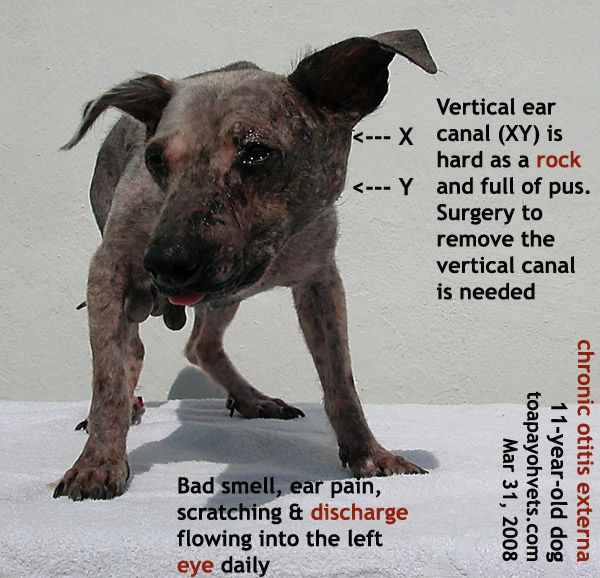
The owner phoned me at 9 a.m to say that his 11-year-old Silkie Terrier passed away in his sleep. His dog just stopped eating for 2 days and he had told me yesterday. The dog had grown hairs and was free of ear pain after my vertical canal ablation surgery in March 2008.


So we thought he would live for some years. Then in June 2008, the dog injured his left foreleg's toe.

The owner tried to treat it himself but the dog just gnaw at his toe till it became much swollen. He had to be operated under general anaesthesia again. I prefer not to operate an old dog a 2nd time. He survived the first general anaesthesia for his ear canal removal and it is better not to take the risk again as old dogs are high risk patients. This was 11 years old and he has reached the limit of his life span.

Now, this dog has a blood clotting disorder. His blood just does not clot easily during surgery. I did not do a blood platelet test to confirm that he had a low platelet count to save on costs for the owner. There is no cure for the idiopathic thromobocytopenic purpura. Idiopathic means that the cause is unknown although it is believed that the body makes antibodies to destroy its own platelet.

This dog would be suffering from a chronic idiopathic thromobocytopenic purpura and like the disease in people, he could live to an old age.


He had a left severe ear pain. Hard as a rock - that's what his left ear vertical canal felt to me. The cure was removal of this vertical canal, a surgery called vertical canal ablation. Now, would he die under general anaesthesia - being aged and thin? At the time of surgery, I did not suspect he had chronic idiopathic thromobocytopenic purpura. In retrospect, some blackish bruises on his bald body could be a tell-tale sign but old dogs may have such blemishes.

In any event, he survived the ear and toe amputation surgeries under general anaesthesia. He lived the last few months of his life without pain in his left ear and for that the owner was very happy that the dog passed away peacefully. I only talked to the owner by phone and had never met him as he is a busy person.


Tentative diagnosis of chronic idiopathic thromobocytopenic purpura in this case:
1. blood does not clot in the ear canal before vertical canal ablation surgery (see pictures).
2. a large haematoma after surgery (swelling above his left parotid salivary gland and where the vertical ear canal was removed, under the healed wound). At the toe amputation surgery, I checked the left facial swelling which was painful if palpated. It was just blood that did not clot. It was around 30 ml of liquid blood.
3. some purplish blood when the bandage wrapping the toe area is removed (see picture).
4. bruises in his body.

The dog was an extremely high anaesthetic risk and yet he survived 2 anaesthesias. Gas anaesthesia at the lowest dose was given. Intubation was done. No tranquilisers or pre-anaesthetic medication was used. No problems encountered during the anaesthesia although this was an old dog nearing the end of his life span. Pain-killers given for 7 days after surgery.

http://www.bekindtopets.com/animals/tpvets_May1308.htm
showed my first meeting with this gentle dog. I thought he was a hairless Chinese crested dog cross bred as he had not much hair. I was glad that the owner did not rush to put him to sleep on March 31, 2008. His wife was against euthanasia and well, this dog spent his last 4 months having a good time with the owner. We just did not expect him to pass away so soon as we got to know him more and his hair was growing back. He looked younger and handsome as his golden Silkie Terrier hair grew luxuriantly in his face and I thought he was rejunvenated. So his early passing away saddened me too.

"The dog is nearing the end of his life span," I said. "He h

DETAILED REPORT TO BE WRITTEN LATER.

Wednesday, July 2, 2008

5. Pyometra in a 4-year-old Lhasa Apso that eats to live

The female Lhasa Apso had sticky vaginal discharge for some time. She was very thin and had a poor appetite for some months.

The owners went to Vet 1 near midnight. The owner did not want blood tests, X-rays or the immediate surgery advised. They had spent some money earlier for a severe diarrhoea treatment of the dog. Veterinary costs can add up when there is prolonged illness requiring many treatments and the family needed to reduce costs.


In this case, it would be prudent not to rush into immediate surgery as the risks of the female dog dying on the operating table would be very high. The challenge is when to commence the removal of the infected womb so that the dog would not die? Give antibiotics and fluid therapy for at least one day and check the rectal temperature to get better odds.


In this case, the dog survived the surgery after around 2 days of treatment. Although I gave her at less than 30% chances of survival, she surprised me. When the vet deems the ill dog a poor anaesthetic risk, the dog would many times prove the vet wrong.


In this case, the family of parents and 2 children came to the surgery and hand-feed the dog 2 hourly for the 2 days before surgery. Feeding 2 hourly after surgery was also essential post-op care. The dog lived.

This dog seemed to be the type that would eat to live, not live to eat.

Yet in Case 3, the other Lhasa Apso with pyometra that I would operate on Friday July 4, 2008 was so much different.

The other Lhasa Apso would be 9 years old and lived to eat. She was trim but not thin. "Always asking for more food," the owner said.

She was given antibiotics for some 7-10 days before surgery. She had very little sticky vaginal discharge as the owner was told to make her wear pads so as to collect some evidence of pyometra - pus in the womb. What would her chances of survival on the operating table?

I assess as more than 50% as the dog was active, trim and eating well. No vomiting. But pyometra had been there for some months as the dog had licked off the vaginal discharge without the owner's knowlege. 2 very small breast tumours had formed. No vet can guarantee 100% survival and this is where early discovery of pyometra or early age spay of the female dog would be preferred. Pyometra can be very stressful for some lady owners, causing sleepless nights prior to surgery.